

Triple Bunk Beds for Small Rooms: Maximize Your Space 2026
- Andy North
- 4 hours ago
- 12 min read

A lot of buyers start in the same place. They've got a ski cabin bedroom in Park City, a narrow guest room in Heber, or a rental bunk room that needs to sleep more people without feeling crammed. They know triple bunk beds for small rooms can solve the headcount problem, but they're not sure whether the room will work, whether guests will be comfortable, or whether the finished result will feel solid enough for real use.
That hesitation is justified. A triple bunk isn't just a bed choice. It's a room-planning decision. In custom bunk work, the projects that turn out best are the ones where the owner stops thinking only about how many people the room can sleep and starts thinking about clearance, circulation, access, durability, and who will use each bunk.
In mountain homes, vacation rentals, and family cabins, that planning matters even more. You're often working with compact rooms, angled ceilings, deep baseboards, window trim, and traffic patterns that look fine on paper but fail once ladders, bedding, and luggage enter the room.
The Essential Planning Phase Before You Buy
A room can look large enough on a listing photo and still fail once the bunk, ladder access, bedding clearance, and guest movement are accounted for. In Park City cabins and rental properties, I start the planning process with the room, not the bed, because a triple bunk only adds value when the space remains comfortable to use every day.
The first screen is ceiling height. A stacked triple twin bunk may fit the floor footprint, but upper-bunk comfort depends on headroom, mattress thickness, guardrail height, and where the ceiling changes across the room. General sizing guidance for triple bunks, including common footprint and top-bunk clearance ranges, is outlined in this sizing guide for triple bunk beds. In practice, I verify those dimensions against the exact wall where the bed will sit, especially in mountain homes with sloped ceilings or heavy trim details.

Measure the room in three dimensions
Length and width are only the start. A builder-level site check looks at the room the way guests will use it after install.
Measure and note:
Overall room size so you can compare bed footprint to remaining open floor area
Ceiling height at the exact bunk location because one wall may work while another does not
Window and door trim projections since trim often steals more usable space than owners expect
Baseboards, outlets, and HVAC registers so the bed does not block daily function
Door swings and closet access so circulation stays open after the bunk is in place
I also mark where someone will stand to make the lower bed, where the climber steps onto the ladder, and where guests will drop bags. Those are the details that separate a room that sleeps three from a room that works well for three.
A compact footprint helps, but placement matters just as much. If you want to see the kind of layout this process supports, a stacked triple bunk bed designed for tight bunk rooms shows how vertical sleeping capacity can preserve floor area when the room is planned correctly.
Map how the room will function
Small bunk rooms in ski cabins and vacation rentals work hard. On a winter weekend, that room may need to handle sleeping, dressing, charging phones, storing duffels, and traffic in ski boots, all within a tight footprint.
Sketch the room and mark these zones:
Entry path from the door to the clear floor area
Ladder or stair access so each sleeper can get in and out without disturbing the whole room
Window access for light, ventilation, and practical reach
Storage use for drawers, shelves, hooks, or luggage
Bed-making space because hard-to-reach bunks create turnover problems in rentals
This is where custom work earns its keep. A stock frame may fit on paper, but it usually ignores the off-center outlet, the deep window casing, or the low slope that cuts into the top bunk zone.
Plan for the occupants, not just the furniture
The age and mobility of the sleepers should shape the plan from the beginning. The U.S. Consumer Product Safety Commission advises that children under 6 should not use upper bunks, as noted in its bunk bed safety guidance. For a family cabin, that affects bunk assignment. For a rental property, it affects who the room suits and how clearly the sleeping arrangement needs to be described in the listing.
I tell owners to pressure-test the room with real use cases. Who takes the top bunk. Who is making the beds between guest stays. Where wet jackets go. Whether an adult can sit on the middle bunk without feeling boxed in. Those answers matter more than the simple claim that the room sleeps three.
Good planning protects comfort, safety, and long-term value. It also keeps you from buying a bed that fits the dimensions but weakens the room.
Choosing Your Triple Bunk Bed Configuration
Once the room qualifies dimensionally, the next question is configuration. Many owners, however, oversimplify this decision. They assume three sleepers means one obvious layout. It doesn't.
The right answer depends on who's sleeping there, how often the room turns over, and whether the room needs to feel open or to sleep the maximum number of guests.

The stacked triple bunk
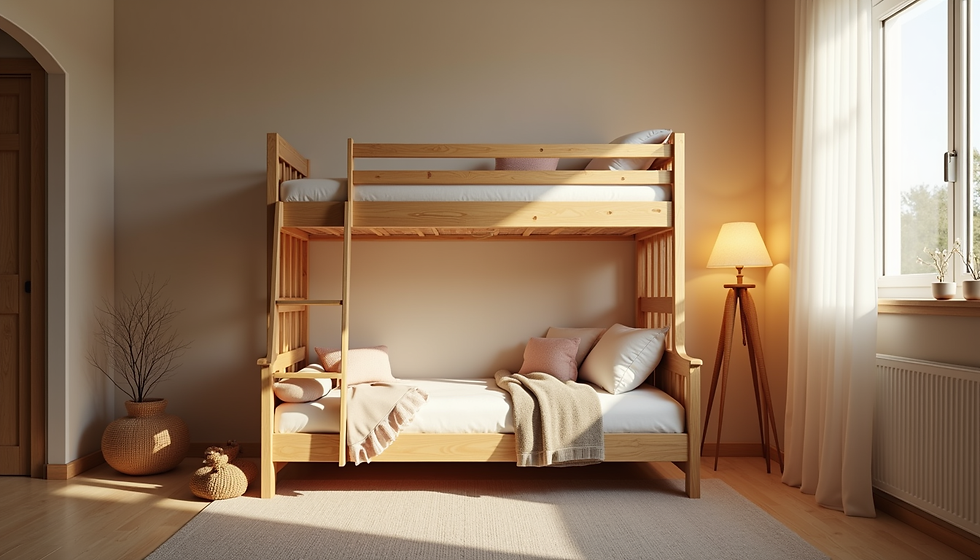
A straight stacked triple is the most efficient option when floor area is tight. It's usually the cleanest answer for a narrow bunk room, a compact guest room, or a ski property where preserving floor space matters more than adding extra furniture.
A design like the Sedona Triple Stack Bunk Bed reflects that approach. It keeps the footprint tight and pushes capacity upward instead of outward.
This configuration tends to work best for:
Very small rooms where every inch of floor matters
Dedicated bunk rooms rather than hybrid office-guest rooms
Properties with a clear age hierarchy where older kids or adults take the upper levels
Its weakness is obvious. Access becomes more vertical, bed-making takes more effort, and the room depends heavily on good headroom planning.
The L-shape and hybrid layouts
An L-shape triple bunk uses corner space more creatively. It can make the room feel less compressed and can leave better visual openness in the center. In some layouts, it also makes it easier to integrate shelving, a small desk area, or storage below one section.
Hybrid layouts such as twin-over-full combinations or a trundle-based third sleeper can also make sense when the room serves more than one type of guest. A family cabin may need a lower bunk that's easier for adults. A vacation rental may benefit from flexibility if different groups book the space throughout the year.
The best bunk room design doesn't chase headcount alone. It balances occupancy, comfort, access, and durability.
That practical view lines up with guidance on evaluating bunk room layouts for long-term use.
What works and what doesn't
Here's the short version I give clients:
Configuration | Works well for | Usually falls short when |
|---|---|---|
Stacked triple twin | Tight rooms, maximum sleeping capacity, simple wall placement | Ceiling height is marginal or guests need easier access |
L-shape triple | Corner layouts, more open center floor, mixed-use rooms | The room is too narrow to absorb the wider spread |
Triple with trundle concept | Flexible guest counts, occasional overflow sleeping | Daily use demands fast turnover and simple housekeeping |
Twin over full style hybrid | Mixed ages, some adult use, more versatile lower sleeping space | The room can't support a wider footprint |
Mass-market bunk beds usually force you to accept the configuration as-is. Custom bunk beds let you solve for the actual problem. In Park City bunk beds and Utah bunk beds work, that often means tuning the layout to a slope, a window wall, or a rental turnover pattern, not just choosing a style from a catalog.
Decoding Clearance Headroom and Safety Standards
This is the part that separates a workable triple bunk from one that looks fine in a product photo but feels wrong in person. Clearance drives comfort, and comfort drives whether the room gets used without complaints.
For adult-rated triple bunk beds, one reference advises looking for verified per-level capacity of 800 to 2,000 pounds, along with 27 to 36 inches between sleeping surfaces for usable sitting clearance and guardrails that extend at least 5 inches above the mattress surface on upper bunks, as outlined in this adult triple bunk specification guide.

Headroom is what guests notice first
People don't talk about “clearance” when they review a bunk room. They say things like “it felt cramped” or “my son kept hitting his head” or “the top bunk was too tight.” That complaint usually traces back to spacing between bunks and how the mattress thickness interacts with the frame.
For custom bunk room design, I look at headroom from three positions:
Getting in and out
Sitting up to read or use a phone
Changing bedding and tucking corners
If the room only works with an overly thick mattress removed from the equation, it doesn't really work. A bunk system should be designed as a complete use case, not as a bare frame diagram.
Guardrails and ladder design aren't decorative details
Upper-level safety depends on practical, visible elements that people use correctly. Guardrails need to be proportioned to the mattress. Ladders need to feel secure and easy to climb, especially in socks, after dark, or for a tired guest arriving late.
A few things matter more than people expect:
Guardrail height relative to the actual mattress
Ladder placement that doesn't block room flow
Attachment points that feel solid under repeated use
Rounded edges and durable touch surfaces in high-contact areas
A good bunk room feels calm to use. Nobody should have to hesitate before climbing into bed.
Why per-level capacity matters more than vague strength claims
One of the most misleading shortcuts in this category is broad language about “heavy-duty” construction without a clear per-bunk rating. In adult bunk beds, rental bunk rooms, and family retreat properties, that distinction matters.
A triple bunk can look sturdy and still be the wrong build for the occupant class. Teen use, adult use, and high-turnover vacation rental use put different stress on joints, ladders, rails, and fasteners. That's why I prefer systems where the expected use is part of the design conversation from the start.
This is also where custom bunk beds differ from one-size-fits-all retail frames. In a real project, you're not just choosing a style. You're choosing a structure that should suit the room, the users, and the wear pattern over time.
Customization Options for Style and Function
Most small-room triple bunks need to do more than hold mattresses. They need to solve storage, access, and finish problems at the same time. That's where custom built bunk beds start to make sense.
A well-designed bunk system can turn an awkward room into one of the most useful spaces in the house. That might mean wrapping a bunk wall into an alcove, matching the trim package so the beds read like built-in bunk beds, or using the dead space below the lower bunk for storage that would otherwise need a separate dresser.

Ladders versus storage stairs
This is one of the biggest planning decisions in a custom bunk room.
A ladder keeps the footprint tight. In very small rooms, that can be the right answer because it preserves circulation. The trade-off is access. Ladders are more vertical, more compact, and less forgiving for some users.
Storage stairs take more floor area, but they often improve everyday usability. They can make upper bunks easier to reach, create better confidence for guests, and add practical storage in the same footprint. If the room allows it, stairs often make the bunk feel more integrated and substantial.
Storage that earns its space
In vacation rental bunk rooms and family cabins, storage needs to be simple and obvious. Guests won't dig through complicated cabinetry. Kids won't use hidden compartments consistently. The best solutions are the ones that stay intuitive.
Useful options include:
Under-bed drawers for extra linens, blankets, or seasonal items
Open shelving for water bottles, books, or charging devices
Built-in cubbies that give each sleeper a personal drop zone
Drawer add-ons such as these under-bed storage drawers when the room needs storage without another furniture piece
The built-in look matters in premium homes
For ski homes, rustic bunk beds, and modern rustic bunk beds, finish and detailing carry a lot of weight. The bed shouldn't look like an afterthought dropped into an otherwise finished room. It should look like it belongs there.
That usually comes down to details such as:
Feature | Why it matters |
|---|---|
Trim integration | Helps the bunk read like permanent architecture |
Finish matching | Ties the bed to wall color, flooring, and millwork |
Panel style | Changes whether the room feels rustic, coastal, or modern |
Shelf and cubby placement | Makes the room easier to live with day to day |
I've seen small mountain rooms in Park City and Midway where the custom work didn't add square footage, but it made the room feel more intentional because every inch had a job. That's a major advantage of customization. It solves several problems with one structure instead of filling a room with separate furniture pieces.
One option buyers may compare during research is Florida Bunk Beds with Nationwide Delivery, which states that it designs custom bunk systems for vacation homes and rental properties with nationwide delivery. For owners comparing providers, the useful point isn't geography. It's whether the company builds around the actual room dimensions, access needs, and occupancy pattern.
Maximizing ROI in Your Vacation Rental Bunk Room
For a vacation rental owner, a triple bunk room isn't just a furniture decision. It's an operational decision. It affects who can book the property, how the room photographs, how housekeeping handles turnovers, and whether guests feel the sleeping setup was thoughtful or crowded.

Triple bunk beds reflect demand for high-density sleeping layouts in valuable real estate markets, and heavy-duty models have moved the category beyond children's furniture into hospitality use, including models described with over 2,000 lbs of weight capacity per level in this market overview of triple bunk usage. That shift matters for owners of ski homes, beach rentals, and investment properties because the room can become real sleeping infrastructure, not just overflow kid space.
More guests only helps if the room works well
Some owners focus entirely on sleeping count. That can backfire.
If the layout is hard to access, hard to clean, or awkward for adults, the added capacity may come with more wear, more frustration, and a weaker guest experience. In bunk beds for vacation homes, the better approach is to ask:
Can guests move around the room without squeezing past ladders?
Can housekeepers make the beds without turning the room into a chore?
Does the room feel intentional in listing photos?
Will the bunks suit the age mix your property usually attracts?
A bunk room should help the property perform, not increase the bed count on paper.
Why distinctive bunk rooms market well
In crowded rental markets, memorable rooms matter. Families notice a clean, built-in-look bunk room because it solves a real travel problem. Group travelers notice when a compact room still feels organized. Property managers notice when guests stop asking where everyone will sleep.
Here's a short video that helps visualize how bunk-focused layouts can change a room's function:
Owners get the best results when the bunk room is designed for repeat use, not just for the listing photos.
Durability protects the investment
Vacation rental bunk beds take more abuse than owner-occupied guest rooms. Different guests use ladders differently. Kids climb rails. Adults put luggage where it doesn't belong. Housekeeping leans on frames while changing bedding. That's normal rental wear.
That's why heavy-duty bunk beds and adult bunk beds make more sense in high-use properties than lightly built furniture-store models. Strong construction, stable access, and a layout that tolerates repeated use usually matter more over time than decorative extras.
For Park City, Heber, and other mountain or destination markets, the best-performing bunk rooms do two jobs at once. They expand sleeping function, and they make the property feel better planned.
From Plan to Placement Your Next Steps
A triple bunk room usually succeeds or fails before the bed is ever built. In vacation properties, I see the same pattern over and over. Owners focus on sleeping count, then run into problems with ladder swing, door clearance, bedding access, or a top bunk that feels too tight once the room is in service.
The right next step is to treat the room like a built-in project, not a boxed furniture purchase. That means planning around guest turnover, cleaning access, wall conditions, window placement, and the kind of wear a rental sees over a full season. A good layout has to work on check-in day, six months later, and after repeated use by families who did not receive an owner's manual.
Bring the right information to the design conversation
Before you reach out, pull together the details that affect the build:
Room measurements, including ceiling height at the bunk wall and any slope or soffit
Photos of doors, windows, trim, vents, outlets, and baseboard heat
Notes on the guest mix, whether the room is for young kids, teens, adults, or mixed groups
Your operating priorities, such as higher sleep count, faster turnover, better storage, or easier climbing access
Good builders can solve a lot. They cannot solve missing information.
Plan for use, not just fit
The strongest bunk rooms are planned around how people will use them on a busy weekend. Housekeeping needs space to make beds. Guests need a clear path at night. Luggage needs a landing spot. Railings, ladders, and mattress heights all affect whether the room feels comfortable or cramped.
That practical planning is what protects the investment. In a Florida beach house, a short-term rental near Orlando, or a family property on the Gulf Coast, the bunk room should add sleeping capacity without turning a small room into a daily hassle.
If you want help sorting out layout options, measurements, or a custom bunk plan, start with a custom bunk bed design inquiry for your Florida property.
Comments